Why Pilates Became My Lifetime Movement Partner (And Why It Could Be Yours Too)
We've all been there. That burst of January energy that leads to a gym membership, followed by the slow fade by March. Or the yoga phase where you felt amazing, but somehow your hamstrings felt looser while your lower back still ached. Maybe you jumped on the CrossFit bandwagon and loved the intensity, until your shoulder started sending you warning signals.
If this cycle sounds familiar, you're not alone. For years, I chased the "perfect" workout—the one that would finally make me feel strong, flexible, and capable without the burnout or the injuries. And then I found Pilates. Not as a quick fix, but as something far more valuable: a lifelong practice that actually respects how the human body is designed to move.
Let's talk about why Pilates has become the most sustainable choice for everyday people who just want to feel good in their bodies—not just for a season, but for life.
The Science of Sustainable Movement
Here's something that might surprise you: the human body isn't designed for isolation. We weren't built to just strengthen our biceps or stretch our hamstrings in a vacuum. We were designed to move as integrated wholes—every joint, every muscle, every breath working in beautiful coordination.
This is where the science gets interesting. Sustainable human movement requires three things working in harmony: strength, flexibility, and mobility. Pull any one of these threads too hard, and the whole fabric starts to unravel.
Strength without mobility creates stiffness. Flexibility without strength creates instability. Mobility without control creates chaos. Pilates understands this intuitively and scientifically. It's not about maximizing any single quality—it's about orchestrating all of them so they support each other.
When you move through a Pilates session, every exercise asks your body to be strong and long, controlled and fluid. That's not just exercise philosophy—that's movement intelligence.
Where Other Workouts Fall Short
Let's be fair to other forms of exercise. They all offer something valuable. But if we're honest about their limitations, we can make smarter choices about how we use them—or why we might choose Pilates as our foundation instead.
Weight Training: The Strength Gap
Traditional gym workouts are masters of building muscle strength. There's nothing quite like the satisfaction of adding another plate to the bar. But weight training, particularly machine-based work, often trains muscles in isolation through fixed movement patterns.
Here's the problem: life doesn't happen in fixed patterns. You don't lift groceries with perfect form while braced against a bench. You twist, you bend, you reach—often all at once. Weight training can leave you strong in the gym but unprepared for the unpredictable demands of real life. It also tends to neglect the smaller stabilizer muscles that protect your joints, which is why so many gym-goers end up with aching shoulders or cranky knees.
Yoga: The Flexibility Puzzle
Yoga deserves so much credit for bringing mindful movement into the mainstream. The flexibility gains are real, and the mind-body connection is invaluable. But here's what I've observed over years of teaching: many dedicated yogis are incredibly flexible but lack the strength to control that flexibility.
This is how we end up with hypermobile students who can fold into beautiful shapes but can't stabilize their own joints. Flexibility without control is actually a liability. Pilates takes the mindfulness of yoga and adds the missing piece—the strength and control that makes flexibility functional rather than risky.
CrossFit and HIIT: The Intensity Trade-Off
There's something undeniably appealing about high-intensity training. The camaraderie, the sweat, the feeling of pushing your limits. CrossFit and similar approaches excel at building mobility and explosive strength while testing your cardiovascular durability.
But intensity has a cost. When fatigue sets in, form breaks down. When form breaks down, injuries happen. The very qualities that make these workouts effective—the speed, the load, the exhaustion—can also make them risky, especially for the everyday person who isn't an elite athlete with a coach watching every rep.
Cardio Training: The Resilience Trap
Cardio builds a beautiful engine. Your heart gets stronger, your stamina improves, your resilience to fatigue grows. But cardio alone leaves you with an engine that's running on an unbalanced chassis. Runners with tight hips, cyclists with rounded backs, swimmers with impinged shoulders—the patterns are everywhere.
Cardio asks your body to endure, but it rarely asks your body to move better. Over time, that imbalance accumulates.
Why Pilates Balances Every Aspect
Here's where Pilates steps in and quietly solves the puzzle that other workouts can't seem to crack.
In a single Pilates session, you're doing something remarkable: you're building strength while improving flexibility, developing mobility while learning control. The springs and straps of the equipment provide resistance that strengthens muscles through their full range of motion—not just in the middle where they're strongest.
This balanced approach means you're not creating weak links. You're not building muscle at the expense of joint health, or gaining flexibility at the expense of stability. Every quality supports every other quality.
Think about the Pilates powerhouse—the deep core muscles, the pelvic floor, the deep spinal stabilizers. These aren't muscles that look impressive in a mirror. But they're the muscles that keep your back healthy, your posture upright, and your movement efficient. Pilates builds from the inside out, which is why the results feel sustainable rather than superficial.
The Low-Injury Factor That Changes Everything
Let me share something that doesn't get talked about enough in fitness: injury risk isn't just about safety—it's about consistency. The workout that injures you is the workout you can't do next week, next month, or next year.
Pilates was literally designed as a rehabilitation method. Joseph Pilates developed this system to help people recover from injury and build bodies that wouldn't break down. Every exercise respects joint mechanics. Every movement has a regression and a progression. There's no "go hard or go home" mentality—there's "move well, then move better."
This low-injury profile isn't just about avoiding pain. It's about creating a practice you can actually stick with for decades. When you're fifty, or sixty, or seventy, you won't regret the workouts that respected your joints. You'll celebrate them.
Well-Being as the Real Goal
Here's the heart of it. If your goal is purely aesthetic—if you're chasing a particular look at any cost—maybe a more extreme approach will get you there faster. But if your goal is well-being, the calculation changes completely.
Well-being isn't just about how you look. It's about how you feel waking up in the morning. It's about bending down to tie your shoes without a grunt. It's about carrying groceries, playing with kids or grandkids, gardening, hiking, dancing at weddings—doing all of it with ease and without fear.
Well-being is the absence of that nagging worry that today might be the day your back "goes out" again. It's the quiet confidence that your body can handle what life throws at it.
Pilates serves well-being because it doesn't ask you to choose between looking good and feeling good. It builds a body that functions beautifully, and the aesthetic results follow naturally. You stand taller, move more gracefully, carry less tension. That's not just exercise—that's transformation.
A Practice for Every Season of Life
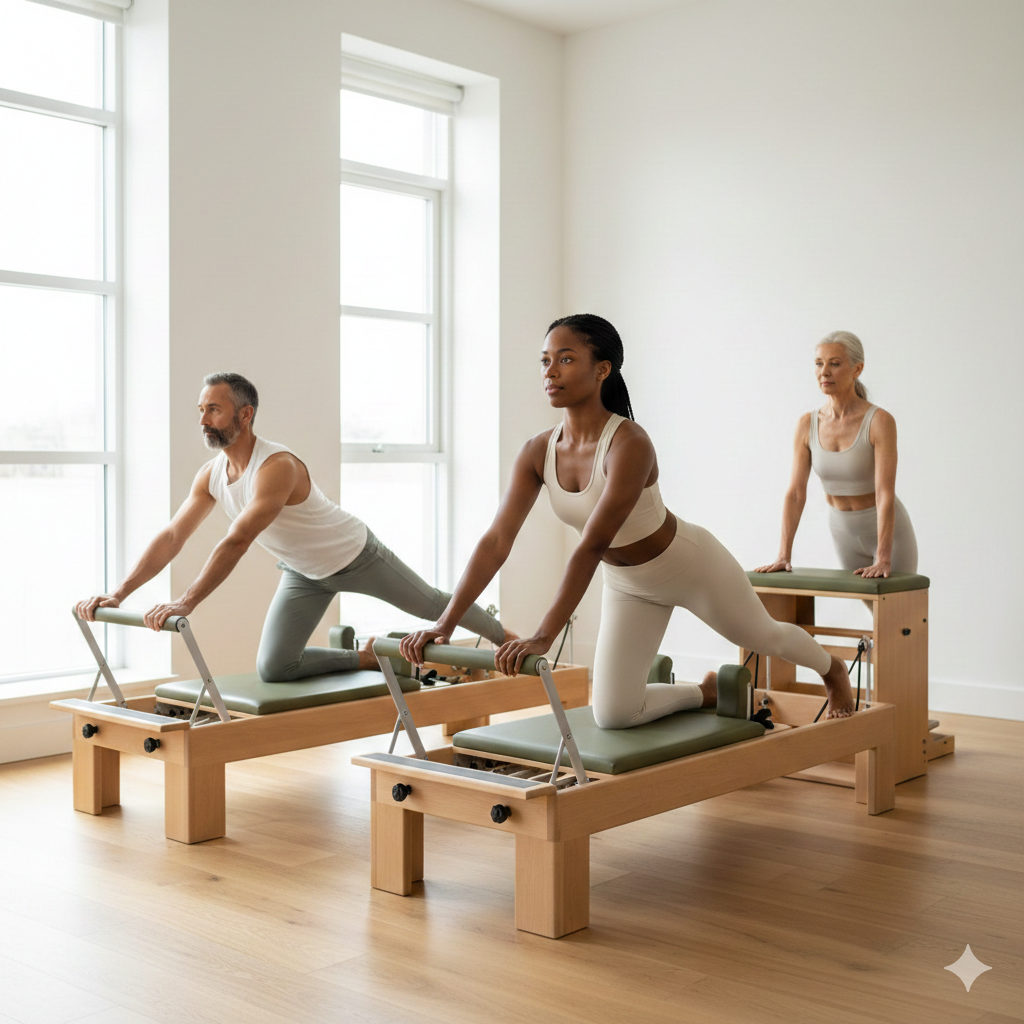
One of the most beautiful things about Pilates is that it grows with you. The twenty-year-old athlete and the sixty-year-old beginner can both find exactly what they need—often on the same equipment, in the same studio.
When you're young and seeking challenge, Pilates offers endless complexity and precision. When you're recovering from injury, it offers gentle, progressive rehabilitation. When you're pregnant, it adapts to support your changing body. When you're aging and want to maintain independence, it preserves the strength and balance that prevent falls.
This isn't a workout you'll age out of. It's a practice you'll grow into.
Making the Shift to Lifelong Movement
If this resonates with you, you might be wondering how to begin—or how to deepen a practice you've already started.
For home users, consistency matters more than complexity. Even ten or fifteen minutes daily on a mat, focusing on the principles of breath, centering, and control, will transform how you feel. As you're ready, adding sessions on equipment—whether in a studio or with home equipment like the reformer—opens up new possibilities for resistance and range of motion.
For new teachers, embrace the depth of this work. The exercises are just the surface. Beneath them lies a philosophy of movement that can truly change lives. Your role isn't just to cue positions—it's to help people discover what their bodies are capable of, safely and sustainably.
The students who find you will come from all those other workouts. They'll come from gyms where they felt strong but stiff. From yoga classes where they felt flexible but fragile. From high-intensity programs where they felt powerful until something broke.
They'll come looking for something that lasts. And you'll have it to offer them.
Because Pilates isn't just another workout. It's movement for life.